Egyptian Farming
Learn about ancient Egyptian Farming, the cultivation of the soil for the growing of crops. The harvesting, types of crops, Ancient Egyptian Irrigation, farming tools and farm animals. 
Ancient Egypt - Egyptian Farming Fact Sheet |
Fact 1 on Egyptian Farming: | 90% of Egypt is desert or semi-arid land. The flooding of the Nile River enabled farming possible surrounding the banks of the river Nile, an otherwise barren region.
| Fact 2 on Egyptian Farming: | The Nile river broke its banks each year, saturating the surrounding countryside with a rich silt, fertile alluvial soil that was ideal for farmland and crop growing. Too little water would cause famine, and too much water would limit the sowing of fresh crops. The water also filtered the land of various salts.
| Fact 3 on Egyptian Farming: | The majority of ancient Egyptians were farmers. The annual flooding of the River Nile was of such importance that the ancient Egyptians based their lives around its yearly cycle.
| Fact 4 on Egyptian Farming: | The work on the farms were based on three periods of farming activity: flooding, sowing and harvesting.
The time of the flood (Akhet) was June - September.
The sowing time (Peret) was October - January
The harvest (Shemu) as February - May
| Fact 5 on Egyptian Farming: | The food crops produced on the farms in ancient Egypt included corn, emmer wheat (barley). Vegetables grown on farms included onions, garlic, leeks, beans, lentils, chickpeas, radishes, cabbage, cucumbers and lettuce. Trees and orchards produced fruit such as dates, figs, pomegranates, melons and grapes.
| Fact 6 on Egyptian Farming: | Grain was extremely important as it was the mainstay of the ancient Egyptian diet. Barley was primarily used for making beer. Wheat was used to make flour to bake bread, the main source of nourishment.
| Fact 7 on Egyptian Farming: | Grain was used instead of money in bartering for goods and taxes imposed by the government were collected in the form of grain. Excess grain was a valuable commodity and used for trade.
| Fact 8 on Egyptian Farming: | The farms also raised or gathered industrial crops that included papyrus, lotus and many other flowering plants, date palm, oils, flax and henna. 
Ancient Egyptian Farmhouse
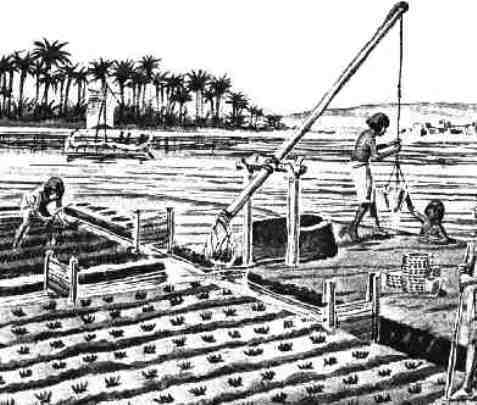
| Fact 9 on Egyptian Farming: | Additional farm land was made available by the development of different forms of irrigation systems so that the water from the River Nile could be introduced inland to fertilize additional lands resulting in more farmland producing more annual crops.
| Fact 10 on Egyptian Farming: | Irrigation was therefore the key to prosperous farms and abundant crops in ancient Egypt. Water was diverted from the Nile to the otherwise desert lands by different methods of irrigation.
| Fact 11 on Egyptian Farming: | Methods of irrigation: Farmers dug trenches to divert water from the Nile river to the farmlands. Man-made ditches, dykes and canals crossed the farmlands. At the entrance of the canals the farmer would have a wood dam to control the water flow. The earth was then moved to other parts of the farm to be used for basin irrigation.
| Fact 12 on Egyptian Farming: | Basin irrigation was the method by which water was trapped in basins that were surrounded by low mud walls. Basin irrigation allowed the ancient Egyptians to control the rise and fall of the river to best suit their farming needs and provided water throughout the farming seasons.
|
|
Ancient Egypt - Egyptian Farming Fact Sheet |
|

Ancient Egyptians Harvesting Grain Egyptian Farming
Discover fast, interesting fun facts about farms in ancient Egypt for kids with some amazing, cool and quick information about Egypt and the ancient Egyptians. Ideal for children, homework, schools, teachers and kids of all ages! Find fascinating fun facts about farms, tools and farm animals for kids and the history, culture and civilisation of the ancient Egyptians and ancient Egypt. Interesting, fun facts about Egyptian Farming for research, schools, students and kids of all ages. |